Every public company invests millions in competitive intelligence. Every analyst on Wall Street reads earnings transcripts looking for hints about future product direction. But the single most revealing source of strategic intelligence is free, public, and updated in real time: job postings.
When a competitor opens a role, they are publishing a fragment of their internal roadmap. A single posting might not tell you much. But a pattern of postings, tracked over weeks and months, paints a remarkably detailed picture of where a company is heading, what technology bets they are making, and which product lines they are about to launch or abandon.
The problem is that most product and strategy teams treat hiring data as an afterthought. They might notice a VP hire on LinkedIn, or a friend might mention that a competitor is “hiring a lot of ML people.” But casual observation is not intelligence. Systematic monitoring is.
This guide walks through exactly how to turn competitor hiring patterns into a predictive model for their product roadmap, and how to act on those predictions before they materialize.
Why Job Postings Reveal Product Strategy
Companies can keep their product roadmap confidential. They can file patents under shell entities. They can embargo press releases and restrict conference talks. But they cannot build products without people, and they cannot hire people without publicly advertising roles.
Every job posting contains multiple layers of signal:
The role itself reveals investment priorities. Three new backend engineers tell you something. Three new backend engineers with “real-time data pipeline” in the job description tell you much more. The specificity of technical requirements in a posting often maps directly to an internal project that has been approved and funded.
The seniority reveals the stage of investment. Early-stage exploration hires tend to be senior individual contributors or “founding” roles. A company posting for a “Founding ML Engineer” is at the beginning of a new initiative. A company posting for five junior ML engineers and a Director of ML Engineering is scaling something that already works.
The reporting structure reveals organizational commitment. When a new role reports to the CTO or CPO, that initiative has executive sponsorship. When it reports to a middle manager in an existing department, it is likely an incremental improvement rather than a strategic bet.
The location reveals market intent. A US-based SaaS company posting engineering roles in London or Singapore is not just hiring remotely. They are building local presence, which usually precedes a push into that regional market.
How to Systematically Monitor Competitor Hiring
Casual LinkedIn browsing will not get you reliable intelligence. Here is a structured approach to monitoring competitor hiring patterns with enough rigor to make product decisions.
Step 1: Build Your Competitor Watch List
Start with your direct competitors, then expand to adjacent players who might enter your space. For most product teams, this list includes:
- Three to five direct competitors (companies your prospects evaluate alongside you)
- Two to three adjacent companies (companies in neighboring categories that could expand into your space)
- One to two “wildcard” companies (large platforms that could build your product as a feature)
For each company, identify their LinkedIn company page, careers page, and any third-party job board profiles. CAM automates this by tracking competitor LinkedIn activity, website changes, and public hiring data in a single dashboard, so you do not need to manually check a dozen sources every week.
Step 2: Categorize Roles by Strategic Signal
Not every hire carries equal intelligence weight. Create a simple taxonomy for the roles you track:
Product expansion signals: Engineers with specific technology expertise (ML, data infrastructure, mobile, specific languages or frameworks), product managers for new verticals, designers specializing in new form factors.
Go-to-market signals: Sales roles targeting new segments (enterprise, mid-market, SMB), regional sales managers, vertical-specific account executives, partnership and channel roles.
Operational scaling signals: Customer success, support, implementation, and onboarding roles. These indicate that an existing product line is gaining traction and needs infrastructure to retain customers.
Leadership signals: VP and C-level hires in new functions, “Head of” roles for departments that did not previously exist, and “Founding” roles that indicate a new team being built from scratch.
Step 3: Track Velocity, Not Just Volume
A single job posting is noise. A pattern is signal. The key metric is hiring velocity: how many roles of a specific type are being posted over a defined time window.
Track this monthly. When a competitor goes from zero ML postings to four ML postings in six weeks, that is a signal. When they post one customer success role per month for a year, that is background noise. When they suddenly post eight CS roles in a single month, that is a churn crisis.
The transition from low velocity to high velocity in a specific function is almost always tied to a strategic decision that was made internally four to eight weeks earlier. That gives you a window to respond.
Patterns That Predict Specific Product Moves
With enough data, certain hiring patterns become reliably predictive. Here are the patterns that experienced competitive intelligence teams watch for.
New Department Formation
When a competitor creates an entirely new function (their first data science team, their first platform engineering group, their first developer relations team), they are making a multi-quarter bet. New departments require a leader, initial individual contributors, and supporting roles. The hiring pattern is distinctive: a senior leader first, followed by two to four ICs within 60 days, followed by a second wave of hires once the leader is onboarded and has defined the team structure.
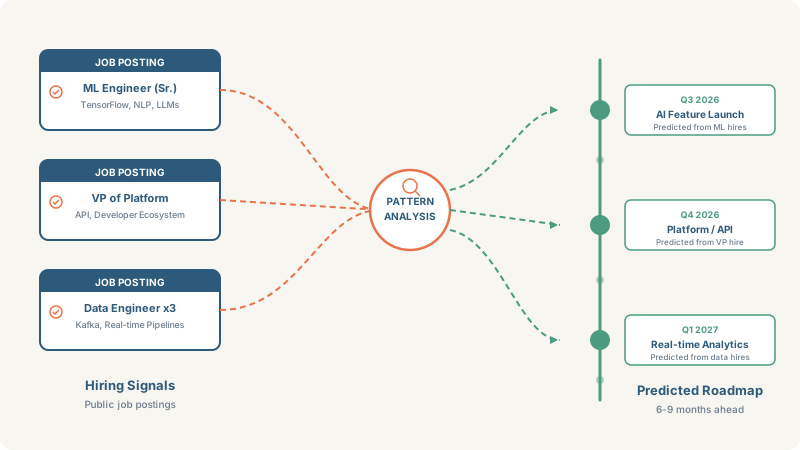
This pattern is the single strongest predictor of a new product line or a major product pivot. If your competitor has never had a platform team and they suddenly hire a VP of Platform Engineering plus three senior engineers, you can be confident that a platform or API product is coming within six to nine months.
Technical Specialization Clusters
When multiple job postings at the same company share unusual technical requirements, those requirements map to an internal project. For example:
- Three roles requiring experience with Apache Kafka and real-time streaming: the company is building a real-time data product
- Two roles requiring experience with HIPAA compliance and healthcare data: the company is entering healthcare
- Four roles requiring experience with Kubernetes and multi-tenant architecture: the company is rebuilding their infrastructure for enterprise-grade deployment
The more specific and unusual the technical requirement, the more confidently you can map it to a product initiative. Generic requirements (“5+ years of Python”) tell you nothing. Specific requirements (“experience with WebRTC and low-latency audio”) tell you everything.
Leadership Hires That Signal Pivots
Certain leadership hires are so predictive that they function almost like press releases. When a B2B SaaS company hires its first VP of Developer Relations, an API or developer platform product is on the roadmap. When an SMB-focused company hires a VP of Enterprise Sales, an upmarket move is imminent. When a product-led growth company hires a VP of Channel Partnerships, they are about to launch a partner ecosystem.
Pay special attention to where leadership hires come from. A VP of Engineering hired from a company known for its real-time collaboration features is likely being brought in to build similar capabilities. The previous employer of a senior hire often reveals the playbook they have been hired to execute.
The Absence of Hiring
Sometimes the most important signal is what a competitor is not hiring for. If a competitor that was aggressively hiring for a specific function suddenly goes quiet, it means one of three things: the project shipped and the team is complete, the project was cancelled, or the company is running into financial constraints.
Cross-reference hiring pauses with other public signals (press releases, product announcements, funding news) to determine which scenario is most likely.
Turning Hiring Intelligence Into Product and Sales Strategy
Raw intelligence is useless without a framework for action. Here is how to convert hiring pattern analysis into concrete decisions.
For Product Teams: Adjust Your Roadmap Proactively
If your analysis shows that a competitor is building a capability you already have, double down on your advantage. Ship improvements, publish case studies, and make it clear to the market that you are the established player in that area before their product launches.
If your analysis shows a competitor investing in a capability you lack, you have a decision to make: build it, partner for it, or position against it. The hiring data gives you six to nine months of lead time to make that decision thoughtfully rather than reactively.
For Sales Teams: Use Hiring Data as Conversation Starters
Competitor hiring patterns are excellent ammunition for sales conversations, especially in competitive deals. When you can tell a prospect, “Your current vendor has posted twelve customer success roles in the last month, which typically indicates retention challenges,” you are demonstrating a level of competitive awareness that builds credibility and plants doubt.
If your team uses Scrubby to validate prospect email lists before outreach, you can pair that clean contact data with hiring-based competitive intelligence to craft highly targeted messaging. Instead of generic outreach, your reps can reference specific competitive dynamics that the prospect is likely experiencing.
For Strategy Teams: Build a Competitive Radar
The highest-value application of hiring intelligence is building a forward-looking competitive radar. This is a living document that maps each competitor’s likely product and market moves based on their hiring patterns, updated monthly.
A competitive radar built on hiring data is more accurate than one built on press releases or analyst speculation, because hiring data reflects actual budget allocation rather than marketing narratives. Companies can say anything in a press release. They cannot fake a pattern of hiring.
CAM makes this process systematic by continuously tracking competitor activity across LinkedIn, company websites, and public channels. Instead of manually checking job boards every week, your team gets automated alerts when competitors show meaningful changes in hiring velocity or direction.
Real-World Examples of Hiring Pattern Prediction
Consider a scenario many product teams have experienced. A mid-market CRM competitor that has historically focused on sales automation suddenly posts five roles: a Director of Customer Success Platform, two engineers with experience in health scoring and churn prediction, a product manager for “customer intelligence,” and a data scientist specializing in predictive analytics. The pattern is unmistakable: they are building a customer success product to complement their CRM.
A product leader who spots this pattern six months before the launch can take several actions. They can accelerate their own customer success features, preemptively position their product as the integrated solution, brief their sales team on the competitive narrative, and reach out to customers who might be evaluating the competitor’s upcoming product.
In another common scenario, an enterprise software company that has been posting exclusively for US-based roles suddenly opens a London office with a General Manager, three enterprise AEs targeting UK financial services, and a solutions engineer with FCA compliance experience. The hiring pattern reveals not just geographic expansion, but a specific vertical and regulatory focus. A competing sales team using a tool like Kali for calendar-based outreach could use this intelligence to accelerate meetings with UK financial services prospects before the competitor’s new team is fully ramped.
These are not hypothetical edge cases. They are patterns that play out across B2B technology markets every quarter. The only question is whether your team is monitoring them systematically or discovering them after the fact.
Getting Started With Hiring Pattern Analysis
You do not need a dedicated competitive intelligence team to begin. Start with these steps:
-
Pick three competitors. Choose the ones that appear most frequently in your deal cycles or that your product team discusses most often.
-
Set up monitoring. Use CAM to track their LinkedIn activity, website changes, and public hiring data. Automated monitoring replaces the manual work of checking job boards and LinkedIn profiles weekly.
-
Create a simple tracking spreadsheet. Log new postings by competitor, role category (product, engineering, sales, CS, leadership), and date. After 60 days, you will start seeing patterns.
-
Brief your product and sales teams monthly. A fifteen-minute monthly briefing on competitor hiring trends is one of the highest-ROI meetings a strategy team can run.
-
Validate your predictions. When your hiring analysis predicts a product launch or market move, note the prediction and check it against reality six months later. This feedback loop will sharpen your pattern recognition over time.
For teams that want to go further, integrating hiring intelligence with other competitive signals (website changes, content strategy shifts, pricing updates, review site activity) creates a comprehensive view of competitor strategy. Platforms like Vendisys can help operationalize this intelligence across your go-to-market motion, ensuring that competitive insights reach the reps and leaders who can act on them.
The Competitive Advantage of Watching What They Build
Product roadmaps are guarded secrets. Hiring plans are public knowledge. The gap between those two facts is the opportunity. Teams that systematically monitor competitor hiring patterns and translate them into product and sales strategy operate with a six-to-nine-month informational advantage over teams that rely on press releases and conference announcements.
That advantage compounds over time. Every quarter of hiring data makes your competitive model more accurate. Every prediction that proves correct builds organizational confidence in the approach. And every proactive decision, whether it is a roadmap adjustment, a targeted sales campaign, or a strategic positioning shift, is one that your competitors did not see coming.
The information is already out there. The only question is whether you are paying attention.