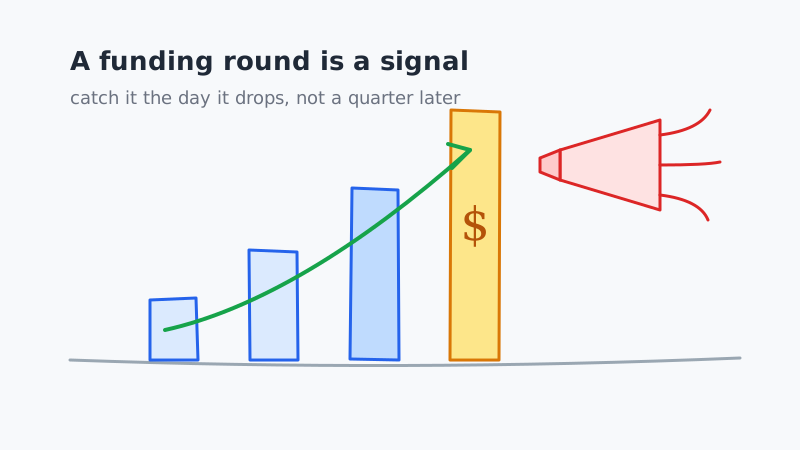
When a competitor raises a round, most teams treat it as news to be mildly annoyed about over coffee. That is a mistake. A funding announcement is not gossip, it is a dated, public declaration of intent. It tells you how much runway a rival just bought, what they plan to spend it on, and roughly when the spending will start. The companies that read that signal correctly, and act in the first week, consistently pull ahead of the ones who notice the headline a month later and shrug.
The catch is timing. A funding signal decays fast. The plays it unlocks (a sales angle, a recruiting push, a partnership conversation) are only sharp while the news is fresh and the competitor is still hiring, still onboarding, still figuring out how to deploy the money. Miss the window and you are reacting to a market that has already absorbed the change.
Why a funding round leaks so much strategy
A raise is expensive to announce and impossible to take back. Founders publish the round, the amount, the lead investor, and almost always a paragraph on what the money is for. That paragraph is the part worth reading twice, because it is the closest thing you will get to a competitor’s roadmap in their own words.
Read across the announcement and you can usually extract three things:
- Direction of spend. “Expanding our go-to-market team” means a sales and marketing surge is coming. “Investing in the platform” means engineering hiring and a product push. The phrasing maps directly to where they will be strong, and where they will be distracted, over the next two quarters.
- Aggression level. A large round relative to their stage signals a land-grab. They will discount harder, hire faster, and chase logos they previously ignored. A modest extension round signals caution, which is its own opportunity.
- Investor thesis. The lead investor’s portfolio and public theses tell you which narrative the competitor just bought into. That is where they will plant their flag next.
None of this is hidden. It is sitting in a press release, a blog post, a TechCrunch piece, and the founder’s LinkedIn. The hard part is not access, it is noticing on the day it happens rather than stumbling onto it weeks later.
The plays a fresh raise unlocks
A funding signal is only valuable if it changes what you do this week. Three plays consistently pay off, and all of them have a short shelf life.
1. The sales counter-narrative
A newly funded competitor will lean on the round in deals: “we just raised, we are the safe bet.” You can get ahead of that. When you know a rival raised on a “growth at all costs” thesis, you arm your sales team with the obvious counter: stability, focus, and customers who are not funding someone else’s experiment. The first reps to walk into a deal already framing the contrast win the framing. The ones who learn about the round from the prospect are on the back foot.
This is also the moment to tighten your outreach. A competitor’s customers are about to be marketed at harder, so reaching them first matters. Make sure the list you are working is clean and deliverable before you scale a campaign, because a bounce-heavy send during a competitive window is wasted timing. Running your prospect list through an email validation tool like Scrubby before a push keeps the campaign landing while the signal is hot, and pairing it with calendar-based outreach through Kali turns “we should reach out” into booked demos before the competitor’s new budget kicks in.
2. The recruiting and talent play
Funding announcements are followed by hiring sprees, and hiring sprees create two openings for you. First, the competitor will post a wave of roles, which tells you exactly which functions they are betting on (read the org chart they are building). Second, and more aggressively, a raise often unsettles existing employees who expected equity to mean something different, and a well-timed message in the weeks after a round lands better than at any other time. The teams watching for the hiring wave get to both poach and prepare before the competitor’s recruiting machine spins up.
3. The partnership and positioning move
A raise reshuffles the partnership landscape. Integrations the competitor ignored when they were scrappy become priorities once they have headcount, and the partners they court next are predictable from the investor thesis. Knowing this early lets you lock in the partnerships you want before a freshly funded rival starts writing bigger checks for the same integrations.
Why this breaks down without monitoring
Every one of these plays depends on speed, and speed is exactly where manual tracking fails. Funding news does not arrive on a schedule. It drops on a random Tuesday, gets a few hours of attention, and then disappears under the next cycle. Nobody on your team is assigned to refresh a competitor’s newsroom every morning, and even if they were, the announcement might break on a paywalled outlet, a niche newsletter, or a single founder’s post before it hits anywhere you would think to look.
The result is the same failure mode every time: the round happened, the window was real, and your team found out three weeks later when a prospect mentioned it. The intelligence was public the whole time. You just were not watching on the right day.
This is the gap continuous monitoring is built to close. Instead of relying on someone remembering to check, you set up tracking on each key competitor’s newsroom, blog, funding databases, and the founders’ and executives’ public profiles, and let the alert come to you. A tool like CAM watches those surfaces continuously and flags a funding announcement (or the hiring wave and messaging shift that follow it) the day it appears, so the play lands inside the window instead of after it has closed. The point is not to read more news, it is to never be the last team to know.
A simple operating routine
You do not need a research department to act on this. A lightweight routine is enough:
- Define the watch list. Pick your five to ten most direct competitors and the surfaces that announce their news: newsroom, blog, the founders’ LinkedIn, and the funding trackers they tend to appear in.
- Automate the alert. Manual checking is the step that always gets dropped, so let monitoring carry it. The signal you care about is rare and high value, which is exactly the kind of thing a human will forget to look for and a system will not.
- Pre-write the plays. Decide now what your sales counter-narrative, recruiting message, and partnership response look like, so that when an alert fires you are executing a prepared move instead of inventing one under time pressure.
- Measure the window. Track how fast you respond to each signal. The goal is days, not weeks, and the gap between those two is usually the difference between leading the reaction and trailing it.
The takeaway
A competitor’s funding round is a free, dated, public preview of their next two quarters. The intelligence is never the problem, the timing is. Teams that catch the announcement on day one get to run their sales, recruiting, and partnership plays while the window is open. Teams that find out a month later get to watch the consequences. The difference between those two outcomes is not effort or insight, it is simply whether someone (or something) was watching on the day the news broke.