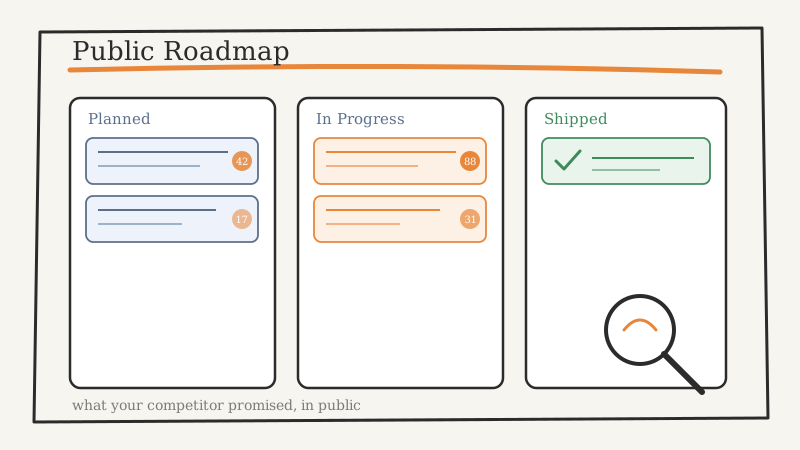
Most competitors guard their roadmap like a secret. Then they turn around and publish a public feature request board where anyone can see what customers are begging for, what the team has promised to build, and what has been sitting in the backlog for two years with 300 votes and no movement.
Public roadmaps and voting boards, the ones hosted on tools like Canny, ProductBoard, UserVoice, and Nolt, are one of the most underused sources of competitive intelligence available. They are literally a list of the gaps in a competitor’s product, ranked by how much their own customers care. Unlike a changelog, which only shows what already shipped, a public board shows what has not shipped yet and how frustrated people are about it. That is the exact territory where deals are won.
This post covers what these boards expose, the specific signals worth tracking, and how to monitor them continuously so you hear about a promised-but-delayed feature while the prospect is still annoyed enough to switch.
Why a Public Board Is Different From a Changelog
A changelog is a highlight reel. It is curated, positive, and written to make the product look like it is always moving forward. A public feature request board is the opposite: it is the raw, unfiltered voice of the customer, and the company has chosen to leave it exposed.
That difference matters for three reasons.
First, a board shows demand, not just supply. You can see how many people voted for a capability, read their comments, and gauge exactly how painful the gap is. A feature with 400 votes and a thread full of “we are evaluating alternatives because of this” is a flashing sales opportunity.
Second, a board shows commitments. When a competitor moves an item to “Planned” or “In Progress,” they have made a public promise with a timestamp attached. If that item then sits in “In Progress” for eight months, you have documented proof of a stalled roadmap that you can reference (carefully and factually) in a competitive deal.
Third, a board shows what the company has quietly given up on. Items marked “Closed” or “Not Planned” tell you where a competitor has decided not to compete. If a prospect needs that capability, the competitor has already told you, in public, that they will not build it.
We wrote separately about reading a competitor’s shipped changes in monitoring a competitor’s changelog and docs to detect roadmap shifts. The public board is the mirror image: it covers everything the changelog will never mention because it has not happened.
The Signals Worth Tracking
Not every board update matters. Here are the movements that consistently translate into competitive and sales value.
High-Vote Requests With No Status
A request that has hundreds of votes and remains untouched (no owner, no status, no team reply) is the clearest signal of an ignored, painful gap. These are your best talking points. The customers who voted are, by definition, people who want something the competitor is not delivering.
Track the top ten most-voted open items on each competitor’s board and watch which ones the team never engages with. Silence on a popular request is louder than any marketing page.
Items Stuck “In Progress”
When a competitor promises something publicly and then fails to ship it for months, that gap between promise and delivery is a credibility problem you can use. The key is to track the date an item entered “In Progress” and how long it has been sitting there. A feature that has been in progress since last quarter tells a prospect a lot about the team’s actual velocity.
Newly Planned Items
When a competitor moves a request to “Planned,” they are signaling their near-term direction. If they just planned a capability you already ship, expect them to start closing the gap in your deals within a couple of quarters. If they planned something in a brand new area, that is an early read on a strategic bet, often earlier than you would catch it from hiring or press.
Frustrated Comments and Churn Language
The comment threads are gold. Phrases like “this is a dealbreaker,” “we are looking at alternatives,” or “how is this still not built” are prospects raising their hand in public. The people writing them are actively unhappy customers of your competitor. This pairs naturally with tracking a competitor’s G2 reviews and turning negative feedback into sales angles, since the same frustration usually shows up in both places.
Closed and “Not Planned” Items
Every rejection is a permanent gap you can rely on. When a competitor explicitly declines to build something, you can position around it with confidence that they are not about to reverse course next month.
How to Monitor a Board Without Checking It by Hand
The problem with public boards is the same as any competitive source: they change quietly and constantly, and nobody has time to visit five competitor boards every morning looking for a status change on a card they might not even remember.
The answer is to monitor the board pages the same way you would monitor any other competitor page, and get alerted only when something actually moves. This is exactly the job a change monitoring tool like CAM is built for. You point it at the board URLs, and it watches for meaningful changes: a new high-vote request, a status flip from “Planned” to “In Progress,” a card that suddenly appears or disappears.
A practical setup looks like this:
- Inventory the boards. Find each competitor’s public board. They are usually at a subdomain like
feedback.competitor.com,roadmap.competitor.com, or a Canny or ProductBoard hosted URL. If you are not sure a competitor has one, checking their subdomains is a good first step, which we cover in monitoring competitor subdomains to detect new products early. - Monitor the high-value views. Watch the “In Progress,” “Planned,” and “Top Requests” views specifically, since those are where status changes and demand shifts appear. A good monitor uses an AI judge to ignore vote-count jitter and formatting noise so you are only alerted on real changes.
- Route alerts to the right people. Send roadmap movement to product and competitive intelligence, and send frustrated-customer signals straight to the sales team who can act on them the same week.
- Log the history. Keep a running record of when each item changed status. That timeline is what turns a single observation into a credible story about a competitor’s delivery track record.
The goal is to move from reactive to proactive. Instead of discovering months later that a competitor shipped something, you see it enter “Planned,” watch it sit, and know precisely when the window is open to go after their unhappy customers. When paired with outbound tools like Kali for booking demos with those frustrated accounts, a single roadmap signal can turn directly into a pipeline.
Turning Board Intelligence Into Deals
Reading the board is only half the value. The other half is what you do with it.
For sales, the play is direct. When a competitor’s top request stalls, build a short list of the accounts most likely to care, and reach out with a specific, factual message about the capability they wanted and cannot get. You are not badmouthing anyone, you are simply showing up with a solution to a problem they publicly asked to have solved.
For product and marketing, the board is a demand-validation engine you did not have to build. If your competitor’s customers are voting hundreds of times for something, that demand exists in your market too. You can prioritize it, ship it, and then point to the fact that you already have what their customers are still waiting on.
For competitive intelligence, the board becomes part of your battlecard. A line like “their customers have been requesting this since last year and it is still unbuilt” is far more persuasive than a generic feature comparison, because it comes from the competitor’s own customers in the competitor’s own words.
The Bottom Line
A public roadmap is a rare gift: a competitor voluntarily publishing their gaps, their delays, and their most frustrated customers in a single, sortable list. The companies that win competitive deals are not the ones who check these boards once a quarter. They are the ones who monitor them continuously, catch the status changes as they happen, and reach the unhappy customer while the frustration is still fresh.
Set up monitoring on your competitors’ public boards, watch the “In Progress” and “Top Requests” views, and let the roadmap tell you where the next deal is hiding.