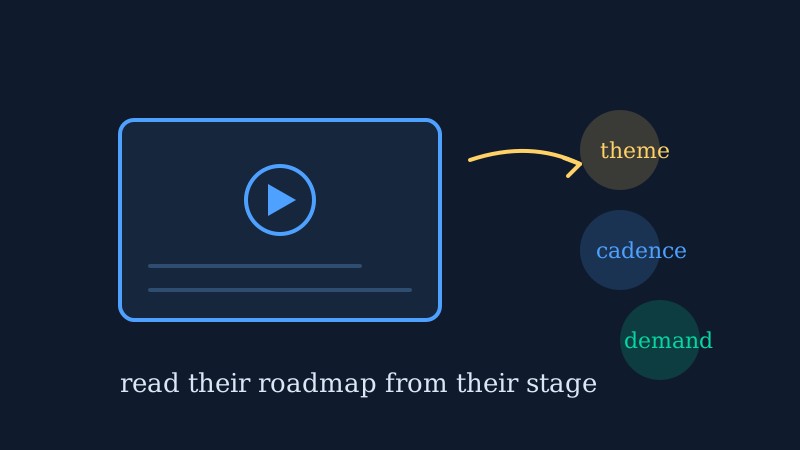
Most competitive intelligence focuses on the obvious surfaces: pricing pages, feature announcements, ad creative. Those are useful, but they are also lagging. By the time a competitor changes their pricing or ships a feature, the strategic decision behind it is months old. If you want to see where a competitor is heading, watch what they put on stage.
A company’s webinar and event calendar is one of the most honest signals it broadcasts, and almost nobody tracks it systematically. The topics a competitor chooses to invest a webinar in, and how often they return to a theme, reveal the demand they are actively trying to create well before that bet shows up anywhere else.
Why the webinar calendar leaks strategy
A webinar is expensive. It costs production time, a speaker, promotion budget, and a slot on the calendar of the exact prospects the company is courting. Companies do not spend that on topics they consider settled or unimportant. They spend it on the narratives they are trying to own.
That makes the topic list a window into three things at once:
- The category they are trying to define. Repeated webinars on a specific concept mean they want to be the authority on it.
- The objection they are trying to dissolve. A sudden run of “how to think about X” sessions usually means X is a sticking point in their sales cycles.
- The buyer they are courting. A shift from practitioner-level topics to executive-level ones signals a move upmarket before the pricing page catches up.
Read across a quarter of their events and the demand-gen strategy assembles itself.
What to actually track
The signal is not in any single webinar. It is in the pattern across time, which is why this has to be monitored continuously rather than checked once. Set up tracking on each key competitor’s events page, resource hub, and the platforms they use to register attendees, and watch for:
- Theme clustering. Three webinars on the same concept in two months is a deliberate ownership play, not a coincidence.
- Cadence changes. A competitor that goes from one event a quarter to one a month has either raised money or made demand-gen a priority. Both matter to you.
- Topic migration. Watch the drift in seniority and use case. It maps their ICP movement in real time.
- Co-marketing partners. Who they put on stage with reveals the integrations and alliances they are betting on next.
Doing this by hand across several competitors is the part that breaks down, because the pages change quietly and nobody remembers to look. This is exactly what continuous monitoring is for. A tool like CAM watches competitor event pages and resource hubs and alerts you when a new topic or cadence shift appears, so the pattern surfaces on its own instead of depending on a manual quarterly audit you will eventually skip.
Turning the pattern into action
Tracking is only worth it if it changes what you do. Once you can see a competitor’s demand-gen bet, you have several moves:
- Counter-program the narrative. If they are working to own a concept, you can either contest it directly or deliberately stake out the adjacent ground they are leaving open.
- Pre-empt the objection. When their webinar topics reveal a recurring buyer objection, you can address it in your own outbound before the prospect even raises it.
- Feed your sales talking points. Knowing the themes a competitor is pushing lets your reps anticipate which framing a prospect has already been exposed to.
That last point connects directly to outbound. If you know the story a competitor has been telling a shared prospect, your outreach can speak to it rather than around it. Teams running structured outbound, whether in-house or through a partner like Vendisys, convert better when their messaging is informed by what the prospect has already heard from the other side.
The cheapest research you are not doing
Competitors will not tell you their strategy, but they will perform it on stage every month, in public, for free. The webinar calendar is sitting right there. The only thing standing between you and that intelligence is a system that watches it consistently. Set the monitoring up once, read the pattern across a quarter, and you will see the next move before it is announced.