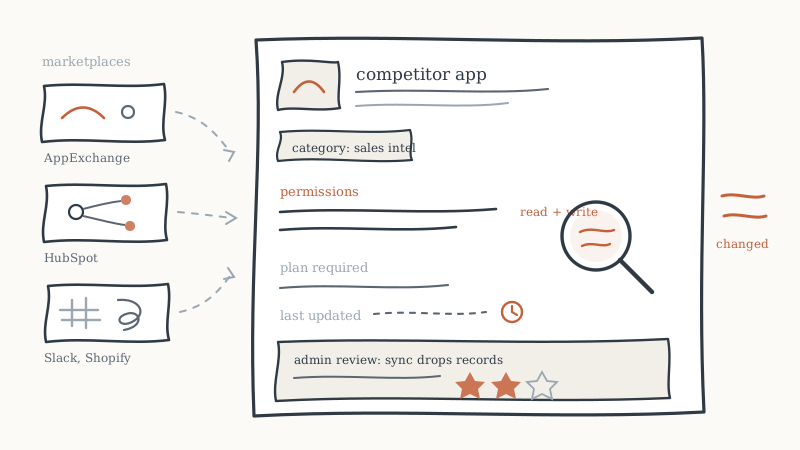
Most competitive intelligence work points at the competitor’s own website. The pricing page, the changelog, the careers board. All useful, all heavily watched. But there is a category of competitor page that sits on somebody else’s domain, gets updated on a predictable review cycle, and is almost never monitored: the SaaS app marketplace listing.
Salesforce AppExchange, the HubSpot App Marketplace, the Slack App Directory, the Shopify App Store, the Atlassian Marketplace. These are not the same thing as the hyperscaler marketplaces. A cloud marketplace listing tells you a competitor is chasing enterprise procurement budget. An app marketplace listing tells you something more tactical and more immediately useful to a seller: which system of record the competitor has decided their buyer lives in, and which workflow inside that system they want to own.
That is a positioning statement, published in public, maintained by the competitor, and reviewed by the platform. It is one of the highest signal pages they do not control the narrative on.
Why an App Marketplace Listing Leaks Strategy
A marketplace listing is an unusually honest artifact. The competitor wrote it, but the platform constrains it, so it tends to be more literal and less aspirational than their homepage.
It names the system of record. Building and maintaining a certified AppExchange listing is real engineering plus a security review. Nobody does that speculatively. If a competitor ships a managed package on AppExchange, their buyers are Salesforce shops. If they ship on the HubSpot App Marketplace first and Salesforce never, they are selling to mid market HubSpot teams. That single fact reshapes how you qualify a head to head deal.
It exposes the actual integration surface. Listings commonly document which objects they read and write, which scopes or permissions they request, whether the sync is one way or bidirectional, and whether it runs in real time or on a schedule. This is the detail your prospect’s RevOps lead will ask about, and the competitor published it for you.
It reveals packaging. Marketplace listings often carry their own pricing tiers, a free or trial edition, and the plan level required to use the integration. When the integration is gated behind the competitor’s top tier, that is a wedge. When it is free, that is a land and expand motion.
It shows which workflow they want to own. Listing categories are chosen deliberately. A competitor that lists under sales intelligence is positioning against your prospecting story. The same company listing under data enrichment or reporting is telling you they have given up on the workflow and are repositioning as plumbing.
It carries public reviews. Marketplace reviews are harder to curate than testimonials on the competitor’s own site, and they are frequently written by admins rather than champions. Admin complaints about sync failures, duplicate records, or permission problems are the most useful objection material you can get for free. We go deeper on turning that kind of feedback into talk tracks in the guide to monitoring competitor customer reviews for churn risk and sales opportunities.
The Specific Changes Worth Watching
Not every listing edit means something. These are the ones that do.
A brand new listing on a platform they were not on
The strongest single signal in this category. A competitor appearing on AppExchange for the first time means they have committed to Salesforce buyers, passed a security review, and built a team that can maintain a managed package. Expect their messaging to shift toward enterprise CRM language within a quarter or two.
A second or third platform added
Breadth tells you about their target market. One platform means focus. Three or four means they are chasing anyone with a CRM, which usually indicates they are growth constrained in their original niche and are widening the funnel.
Scopes and permissions expanding
When a listing starts requesting write access to objects it previously only read, the competitor is moving from a reporting add on to a system that mutates your prospect’s data. That is a product ambition signal and a competitive escalation. It also raises the security questions your champion’s IT team will ask, which you can get ahead of.
Category or tagline changes
A quiet edit to the listing title or category is a repositioning tell, and it often lands weeks before the competitor’s own homepage changes. If you also track their site copy, you get the sequence. Our walkthrough on monitoring competitor homepage hero headline changes pairs well with this, because the marketplace edit frequently comes first.
Version history going quiet
Most marketplaces publish a release or last updated date. A listing that has not shipped a version in a long stretch, while the competitor keeps announcing features elsewhere, suggests the integration is unmaintained. That is a fair and verifiable question to raise in a deal: when was this last updated?
A listing disappearing
Delistings happen for unglamorous reasons, including failed re-review, abandoned maintenance, or a strategy change. Whatever the cause, a competitor who no longer has a listing on the platform your prospect runs on has a real gap, and you should know the day it opens.
Support and documentation links changing
When the support URL moves from a generic contact form to a dedicated help center, or when a partner implementation firm appears on the listing, the competitor is building out the services layer that enterprise deals require.
How to Actually Monitor This
The manual version is someone on your team opening five marketplace pages every Monday. That lasts about three weeks. Build it as a monitored surface instead.
Inventory the listings first. For each competitor, search every marketplace your buyers plausibly use and record the exact listing URL. Search by company name and by product name, because many vendors list under a product brand that does not match their domain. Keep the list in the same place as the rest of your competitor page inventory.
Snapshot the whole listing, not just the page. Capture the title, tagline, category, description, pricing block, requested scopes, supported editions, last updated date, version number, and review count. Marketplace pages are heavy on dynamic chrome, so target the specific content regions rather than diffing the entire document, or you will drown in noise from rotating recommendations and review carousels.
Set different thresholds per field. A new review should be a low priority digest item. A change to requested permissions, a new platform listing, or a delisting should alert immediately. Treating every diff as equally urgent is the fastest way to get the whole feed muted.
Watch the partner directories too. Most platforms maintain a separate consulting or solution partner directory. A competitor acquiring named implementation partners there is building a channel, which usually precedes a push into larger accounts.
Route the output to where deals happen. A marketplace diff that lands in a channel nobody reads is not intelligence. The admin complaint you found in a review is only worth something if the rep working that account sees it before the technical evaluation call.
Turning the Signal Into a Play
Integration depth as a qualification question. Once you know the competitor’s listing is read only, or schedule based rather than real time, you can ask your prospect what they need instead of asserting what the competitor lacks. The prospect discovers the gap themselves, which lands better than a slide.
Maintenance as a trust question. A long stale version history is a legitimate risk to surface with a buyer who is about to depend on that integration.
Reviews as objection prep. Mine admin reviews for the recurring failure modes, then prepare honest answers for how you handle the same scenario. If you keep a battle card, this is exactly the kind of sourced detail that belongs on it. The walkthrough on how to build a competitor battlecard from monitoring data covers how to structure it so reps actually use it.
Platform gaps as territory. If a competitor has no listing on the platform your best accounts run on, that is a segment where the technical evaluation tilts your way before the conversation starts.
Where Marketplace Monitoring Stops Being Enough
Listing monitoring tells you what a competitor has built and who they built it for. It is strategic context, and it moves on a slow clock. A listing edit tells you nothing about which specific companies that competitor is selling to this week.
That is a different kind of signal, and it comes from a different surface. CAM was built for it. CAM continuously monitors the new LinkedIn connections your competitors’ sales reps make, enriches each one with job title, company, industry, size, website, and location data, scores it against your ICP, and delivers a ranked lead list every week alongside real time alerts. A new AppExchange listing tells you the competitor is going after Salesforce shops. The connections their reps made last week tell you which Salesforce shops, by name, while the deal is still open.
The two layers work together. Use marketplace listings to understand the competitor’s chosen battlefield, and use LinkedIn connection tracking to see which accounts they are actually fighting for on it. Because connection monitoring syncs into HubSpot, Salesforce, and Clay, the accounts surface inside the CRM your reps already work out of, which is the same system of record the competitor’s marketplace listing just told you they care about.
Start With One Marketplace
You do not need a full monitoring program to get value here. Pick the one platform your buyers most commonly run on. Pull up every competitor’s listing on it. Read the categories, the requested scopes, the pricing gates, the last updated dates, and the most recent admin reviews.
You will learn more about your competitors’ real product boundaries in that hour than from a month of reading their blog. Then put the pages under monitoring so the next change reaches you on the day it ships, rather than during a technical evaluation you are already losing.