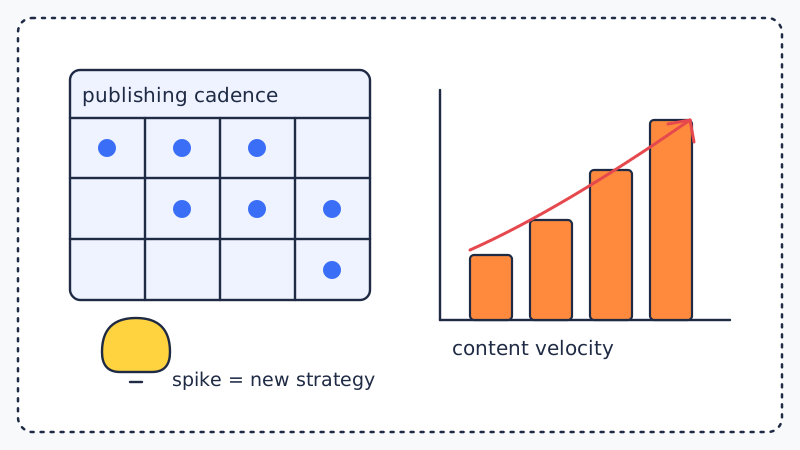
Most competitive teams read a competitor’s blog for what it says. They scan the latest post, note the topic, maybe forward an interesting one to the sales channel, and move on. That misses the more valuable signal, which is not in any single post at all. It is in the rhythm: how many posts go out, how often, and how that rhythm changes over time.
Publishing cadence is one of the cleanest proxies for where a competitor is spending money and attention. A content program does not speed up by accident. Someone hired writers, approved a budget, set a quota, and pointed the whole machine at a goal. When the machine changes speed, it is telling you something concrete about the competitor’s plans, usually a quarter or two before the results show up in search rankings or pipeline.
This post covers what content velocity actually measures, how to read specific cadence changes as strategy signals, and how to monitor it continuously without reading every post by hand.
What content velocity really measures
Content velocity is simply the rate at which a competitor ships new published content over a given window: posts per week, per month, or per quarter. On its own the raw number is not that interesting. Big companies publish more than small ones, and some categories are just noisier than others. The signal lives in the change and in the shape of that change.
Velocity is a good proxy because a blog program is expensive and deliberate. To sustain four posts a week, a company needs writers, editors, an SEO lead, a content calendar, and someone approving spend against a target. You cannot fake that rhythm for long. So when the rhythm shifts, it reflects a real decision that was made upstream: a hire, a budget reallocation, a new go-to-market motion, or a bet on owning a set of keywords.
That is why cadence is worth watching even when the individual posts look unremarkable. The posts are the output. The velocity is the strategy.
The cadence changes that carry the most signal
Not every wobble in a publishing calendar matters. Content teams take holidays, batch posts, and have slow months. What you are looking for is a sustained change in pace or direction. Here are the patterns that reliably mean something.
A sudden acceleration
A competitor that published twice a month for a year and suddenly jumps to twice a week has made a decision. The most common causes are a new content or SEO hire, a fresh demand-gen budget tied to a pipeline target, or a deliberate land grab on a keyword cluster. A sustained acceleration is one of the earliest signs that a competitor is about to get louder in your shared market. It usually shows up months before their organic traffic and inbound pipeline actually grow, which is exactly the window you want to be watching.
A sudden slowdown or a stall
The reverse is just as informative. A blog that goes quiet after a steady run often trails a reprioritization, a layoff in marketing, or a pivot of resources into product or paid channels. If a competitor’s content engine stalls for a couple of months, their inbound pipeline will soften on a lag. That is a moment to lean into your own content and outbound while their top-of-funnel goes cold.
A shift in topic mix
Velocity is not only about count. Watch what the new volume is about. A company that suddenly floods its blog with posts about a new use case, a new vertical, or a new buyer persona is telegraphing where it wants to grow next. When the cadence spikes and the topics cluster around a theme you have not seen from them before, that theme is very likely their next product line or their next target segment.
A move up or down market
The reading level, the depth, and the buyer sophistication of new content drift when a company changes who it is selling to. A run of deep, technical, enterprise-flavored posts after a history of light how-to content is a fingerprint of a move upmarket. A sudden run of beginner content can mean the opposite, a push to capture a broader, lower-cost segment.
Format and channel expansion
Cadence changes sometimes show up as new formats rather than more blog posts: a new resources hub, a glossary, a comparison-page library, or a wave of gated assets. A competitor building out comparison and alternative pages at speed is preparing to fight for bottom-of-funnel search terms, often the exact terms your buyers use. That is a direct competitive threat, not just a content note.
Reading velocity alongside your other signals
A cadence change is strongest when you line it up with everything else you already track about a competitor. One signal is a data point. Several aligned signals are a strategy you can plan around.
A content acceleration next to a fresh round of marketing hires and a new funding announcement is a coherent story: the competitor raised, staffed up, and is about to spend hard on demand generation. A content stall next to sales-team departures and a stale changelog points the other way, toward a company pulling back. The blog is one of the most public and highest-frequency surfaces a competitor has, which makes it an ideal heartbeat to read the rest of your intelligence against.
This is where continuous website monitoring earns its keep. Watching a competitor’s blog index, sitemap, and content hub for new URLs turns cadence from something you would have to audit by hand into a live feed. A tool like CAM is built to watch competitor pages continuously and alert you only when something meaningful actually changes, so a new post or a burst of new URLs reaches your team the same day instead of at your next quarterly review.
How to monitor content velocity without reading every post
You do not need to read a competitor’s blog daily to track its pace. You need to watch the right surfaces and let change detection do the counting.
- Watch the blog index and any category pages. The index page updates every time a new post ships, so monitoring it gives you a running count of publishing events without opening a single article.
- Monitor the sitemap and the RSS feed. These are machine-readable lists of published URLs. A monitoring tool that watches the sitemap will surface every new post URL as it appears, which is the cleanest possible measure of cadence with no copy noise to filter.
- Track the resources, glossary, and comparison hubs separately. Format expansion often happens outside the main blog. Watching these hubs catches the bottom-of-funnel build-out that a blog-only view would miss.
- Filter out the noise. You do not want an alert every time a timestamp or a tracking parameter changes on the index page. This is where change detection with a smart filter matters, so you only hear about genuine new content and not cosmetic churn.
- Log the events over time. Cadence is only meaningful as a trend. Keep a simple running record of publish dates so an acceleration or a stall is obvious at a glance, rather than something you have to reconstruct from memory.
The goal is to compress the gap between when a competitor changes its content pace and when your team can act on it, from a quarterly audit down to the same week.
Turning a velocity signal into action
Catching the change is only half the value. The other half is doing something with it while the competitor is still committing resources.
For marketing. If a competitor is accelerating into a keyword cluster you care about, decide fast whether to defend it or cede it. Ship your own cornerstone content and refresh the pages that already rank before their new volume compounds. If they are stalling, that is your window to publish aggressively and take share of voice while their engine is cold.
For sales and outreach. A content acceleration aimed at a new vertical tells you which accounts the competitor is about to chase. That is a reason to reach those accounts first. Pairing content-velocity signals with outbound timing tools like Kali lets you get to the segment the competitor is targeting before their demand-gen push warms it up. And whichever accounts you go after, clean prospect data from tools like Scrubby keeps your outreach list healthy so the timing edge does not get wasted on bounced sends.
For product and strategy. A sustained topic shift in a competitor’s content is a roadmap leak. When the cadence spikes around a use case they have never talked about, treat it as an early read on their next launch and pressure-test your own positioning against it now, not after they announce.
The bottom line
A competitor’s blog is not just a source of topics to skim. Its rhythm is a resourcing and strategy signal that updates almost daily and shows up months before the results do. A sudden acceleration means someone got hired and funded. A stall means someone got reprioritized. A topic shift means someone is planning a move.
Pick the surfaces that carry the signal, the blog index, the sitemap, the category and comparison hubs, and put them under continuous monitoring so cadence becomes a live feed instead of a quarterly chore. When the pace changes, read it against the rest of your competitive intelligence and act while the competitor is still mid-decision. That is how a boring metric like posts per week becomes one of the earliest warnings you get about what a competitor is going to do next.