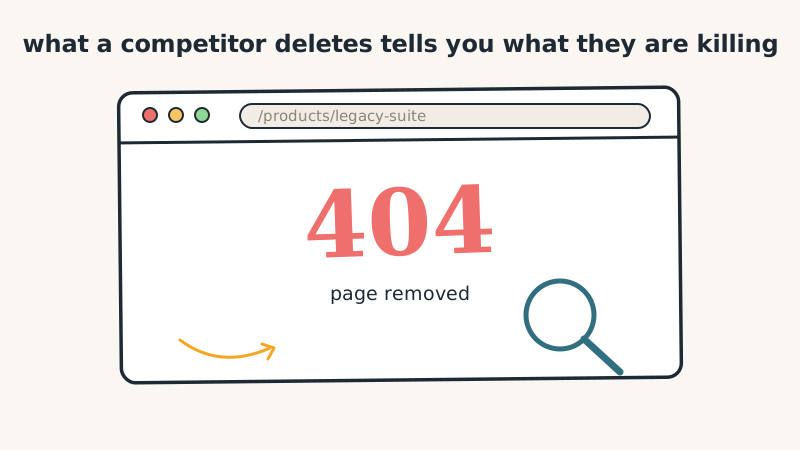
Most competitive intelligence is built around addition. You watch for the new feature page, the new pricing tier, the new case study, the new job posting. Growth is loud, and it is easy to track. So that is where everyone points their attention.
The problem is that subtraction is often the more useful signal, and hardly anyone watches for it. When a competitor deletes a page, they are not tidying up. They are telling you, in the most concrete way possible, that they have decided to stop investing in something. A product got sunset. A pricing tier got pulled. An integration got dropped. A whole market segment got abandoned. None of that shows up in a press release, but all of it shows up as a page that used to resolve and now returns a 404.
This post is about reading the negative space of a competitor’s website: what they remove, what it means, and how to catch it automatically instead of stumbling on it months later.
Why a Deleted Page Is More Honest Than a New One
A new page is marketing. It is written to make something sound bigger, better, and more inevitable than it actually is. Companies launch pages for features that are barely built and markets they are only testing. So a new page tells you what a competitor wants you to believe about their direction.
A deleted page is the opposite. Nobody removes a page to impress you. Pages get pulled because keeping them alive costs something: support burden, engineering maintenance, sales confusion, or the embarrassment of advertising a product they no longer want to sell. Removal is a decision made under internal pressure, and those decisions map directly to where a company is actually cutting.
That is what makes 404 monitoring so valuable. It bypasses the marketing layer entirely. You are not reading what a competitor says about their strategy, you are watching what their strategy forces them to abandon. When a page that has existed for two years suddenly disappears, something real changed inside that company, and you found out before their customers did.
The Pages Worth Watching for Disappearance
Not every removed page matters. A blog post from 2019 getting cleaned up is noise. Here are the removals that reliably signal something strategic.
Product and Feature Pages
This is the highest value signal in the entire category. When a dedicated product page or a feature page goes from live to 404, the competitor is sunsetting that product. Sometimes they redirect it to a broader page, which is a softer version of the same message: the thing no longer deserves its own real estate.
For sales, this is gold. If a competitor kills the exact product a prospect is currently evaluating them for, your rep now has a timely, factual reason to reach out. You are not speculating about their roadmap, you are pointing at a page that used to exist and no longer does. Pair this with a competitor battlecard built from monitoring data so the whole team knows how to position the moment a competitor retires a capability.
Pricing Tiers and Plan Pages
Pricing pages change constantly, but a removed tier is different from a repriced one. When a competitor deletes their entry level plan, or their free tier quietly stops resolving, they are moving upmarket and abandoning the low end. When their enterprise page disappears, they may be retreating from a segment that was too expensive to serve.
Every one of these shifts creates an opening. A competitor who kills their cheapest plan just handed you every price sensitive prospect in their pipeline. Tracking pricing structure over time, including what gets removed, tells you where the soft underbelly is. This complements watching for pricing changes to adjust your positioning in real time, where the removed options matter as much as the new numbers.
Integration and Partner Pages
Integration directories are a running map of a competitor’s ecosystem. When an integration page vanishes, a partnership ended or an integration broke and got pulled rather than fixed. That is a real gap, and if you support the integration they just dropped, it is a direct wedge in any deal where that connection matters to the prospect.
A whole partner program page disappearing is a louder signal still. It usually means the channel strategy failed or got reorganized, which tells you something about how the company is choosing to grow, or struggling to.
Careers and Team Pages
A careers page that empties out, or specific role pages that get pulled without being filled, can signal a hiring freeze or quiet cuts. A leadership or team page that loses names points to departures. On their own these are weak signals, but combined with product page removals they help you tell the difference between a focused pivot and a company under real financial strain.
How to Read a 404 Correctly
A disappeared page is a signal, not a conclusion, and the interpretation matters as much as the detection.
First, check whether the URL truly 404s or quietly redirects. A hard 404 means the content is gone and often unmourned. A redirect to a broader page usually means a consolidation: the feature still exists but has been folded into something bigger, which is a demotion rather than a death. A redirect to the homepage is the strongest form of erasure, because they did not even bother to send you somewhere relevant.
Second, look at what happens around the removal. A single product page dying in isolation might just be a rebrand. That same page dying in the same week the pricing tier for it disappears and the related help center articles get pulled is a coordinated sunset. Clusters of removals are far more meaningful than any single one, so watch the pattern, not just the point.
Third, timestamp it. Knowing that a page died is useful. Knowing it died three days ago, right before a competitor’s earnings call or right after a leadership change, turns a fact into a story you can act on.
Why Manual Checking Fails Here
Removals are uniquely hard to catch by hand, which is exactly why they stay invisible for so long. You cannot notice the absence of a page you were not already looking at. Nobody bookmarks a competitor’s obscure integration page and revisits it weekly on the off chance it disappears. New pages announce themselves in your feed or their newsletter. Deleted pages announce nothing. They just silently stop existing, and the only way to notice is to have been tracking that exact URL over time.
That is precisely the job for automated monitoring. A tool like CAM watches the specific competitor URLs you care about and alerts you the moment one changes state, including when a live page starts returning a 404 or begins redirecting somewhere new. Instead of hoping you happen to revisit the right page on the right week, you get told the day the change happens, with the before and after captured for you.
The setup is the same discipline you would apply to any competitor website change tracking that reveals repositioning signals. You choose the URLs that would mean something if they vanished: every product page, every pricing tier, the integration directory, the key feature pages, the careers page. Then you let the monitor watch them continuously so removals surface as events instead of eventual discoveries.
Turning Removals Into Action
Once you are catching disappearances, the value comes from routing them to the right place fast.
Send product and feature removals straight to sales, tagged with which prospects are currently evaluating that competitor for that capability. A retired feature is a reason to call today, not next quarter.
Send pricing tier removals to your marketing and pricing teams. A competitor abandoning a segment is a chance to capture it, and the messaging writes itself when you can point to the plan they just deleted.
Send integration and partner removals to product and partnerships. Each one is either a gap you can fill or a signal about which ecosystems are worth investing in, based on which ones your competitor could not sustain.
Log every removal with a date and a screenshot so you build a timeline of contraction over months. One deleted page is an anecdote. A year of tracked removals is a map of exactly where a competitor is retreating, and that map is worth more than any launch announcement they will ever send you.
The Signal Everyone Else Misses
Competitive intelligence has a bias toward what is new, because new things are easy to see and satisfying to track. But companies reveal their real priorities not just by what they build, but by what they are willing to let go of. The page they delete is a decision they have already committed to, made without any intention of telling you.
Start watching the negative space. Point a monitor at the competitor URLs that would matter if they vanished, and let the 404s come to you. While everyone else is celebrating their competitors’ launches, you will be the one who noticed what they quietly killed, and moved on it first.